
Why Are People Searching for the Villora Official Website and Nurture Gut Support?
People search for the Villora official website to verify ingredients, price and guarantee before buying a daily gut supplement. Villora sits in a crowded niche: fiber and probiotic support in one capsule, aimed at everyday digestive regularity and comfort.
Gut health attracts attention because the digestive tract hosts trillions of microorganisms, collectively called the gut microbiota. Diet, fluid intake and fiber all influence how it behaves. Villora is built around that idea.
This page answers the questions a careful reader asks. What is in Villora? Why is each ingredient there? Is there evidence behind it? What does Villora cost, and who should be cautious?
What Are the Quick Facts About Villora?
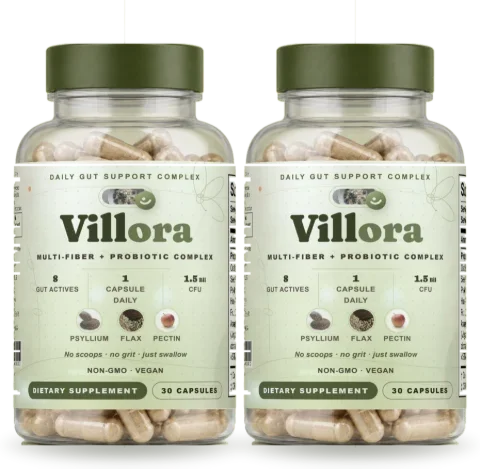
Villora is a 30-capsule bottle of vegan daily gut support. Each capsule combines a 695 mg proprietary multi-fiber blend, green black walnut hull and 1.5 billion CFU of Lactobacillus acidophilus, sold from $49 per bottle with a 60-day guarantee on the Villora official website.
| Product | Villora (Daily Gut Support Complex) |
|---|---|
| Category | Dietary supplement, vegan vegetable capsule |
| Directions | One capsule daily with water; confirm on your bottle |
| Bottle size | 30 capsules (about one month) |
| Fiber blend | 695 mg proprietary blend; individual fiber amounts not published |
| Six fibers | Psyllium husk, oat bran, flaxseed, apple pectin, konjac root, plum powder |
| Botanical | Green black walnut hull (Juglans nigra) |
| Probiotic | Lactobacillus acidophilus, 1.5 billion CFU |
| Manufacturing | USA; brand states a GMP-certified facility |
| Starting price | From $49 per bottle |
| Guarantee | 60 days; return terms apply |
| Sold through | The Villora official website |
What Is Villora and Who Is It Designed For?
Villora is a dietary supplement sold as a daily gut support capsule. It combines six plant fibers, one botanical and one probiotic. It is designed for adults who want a simple once-daily routine for digestive regularity and everyday gut comfort, alongside a balanced diet.
The brand describes Villora as three jobs in one capsule. It frames them as “sweep, cleanse, repair”: fibers to sweep, green black walnut hull to cleanse, and a probiotic to repopulate. Those are marketing labels, not clinical endpoints, and later sections test them against research.
Villora is a supplement, not a drug. It is not meant to diagnose, treat, cure or prevent disease. The NIH consumer fact sheet reminds readers that many supplements have never been studied, so effects of a specific product may be unknown.
Why Does Villora Stand Out From Other Daily Gut Supplements?
Villora stands out because it combines three categories usually sold separately: multiple fibers, a traditional botanical and a probiotic. It also uses a single small vegan capsule, which suits people who dislike fiber powders, scoops or drinks.
Three formats in one
Most products offer only fiber or only a probiotic. Villora packs six fibers and L. acidophilus together, so one daily step covers two mechanisms.
Named ingredients
All eight Villora ingredients are named publicly, which lets you research each one. That is more open than products listing only “digestive blend”.
Capsule convenience
A single vegan capsule removes mixing and taste concerns. Convenience improves routine consistency, which matters for any daily supplement.
Risk-limiting guarantee
A 60-day money-back guarantee, according to the brand, lets you judge Villora over a realistic trial window instead of a few days.
| Feature | Villora | Standalone fiber | Standalone probiotic |
|---|---|---|---|
| Fiber types | Six | Often one | None |
| Probiotic | 1.5B CFU L. acidophilus | None | Yes, strains vary |
| Botanical | Green black walnut hull | Rarely | Rarely |
| Format | One capsule | Powder, drink or capsule | Capsule, gummy or powder |
| Dose clarity | Blend total only | Usually grams per serving | Usually CFU listed |
The trade-off is visible in the last row. A proprietary blend simplifies the label but hides the dose of each fiber, which is the key variable in fiber research.
What Are the Villora Ingredients and What Does Each One Do?
Villora contains eight named ingredients: psyllium husk, oat bran, flaxseed, apple pectin, konjac root and plum powder as fibers, plus green black walnut hull and Lactobacillus acidophilus. Each card below explains why it is included, what research says, and a verdict.
The six fibers share a 695 mg proprietary blend. Because per-fiber amounts are not published, every verdict below separates what the ingredient can do in research from what a sub-gram share can realistically deliver.
1. Psyllium husk
- Why it is in Villora
- Psyllium absorbs water and forms a soft gel. This bulks and softens stool, supporting regular, easier passage.
- What research shows
- A BMJ Clinical Evidence systematic review found ispaghula husk (psyllium) seemed to improve overall constipation symptoms more effectively than lactulose. A 2022 meta-analysis of randomized trials in the American Journal of Clinical Nutrition assessed fiber supplements in adults with chronic constipation.
- Dose note
- Trials use multi-gram servings. Villora’s whole blend is under one gram.
2. Oat bran
- Why it is in Villora
- Oat bran supplies beta-glucan, a viscous soluble fiber that thickens intestinal contents and is fermented by gut bacteria.
- What research shows
- The FDA’s 1997 final rule on oats and coronary heart disease authorized a health claim for soluble fiber from whole oats within a low saturated fat diet. FDA materials note that about 3 grams per day is needed for a cholesterol effect.
- Dose note
- The oat evidence is about cholesterol at gram-level intakes, not about a sub-gram blend.
3. Flaxseed
- Why it is in Villora
- Flaxseed contains soluble mucilage that turns slippery in water, plus insoluble fiber that adds bulk. Together they round out the texture and fermentation profile of the blend.
- What research shows
- Flax studies commonly use ground seed in tablespoon-sized portions, far above a capsule share. No Villora-specific data exist.
4. Apple pectin
- Why it is in Villora
- Pectin is a soluble fiber that colon bacteria ferment. It is included to feed the gut microbiota and soften stool consistency.
- What research shows
- A systematic review in Nutrients reported that pectin is largely fermented in the large intestine, but most evidence comes from in vitro studies and human trials remain scarce.
5. Konjac root
- Why it is in Villora
- Konjac glucomannan is among the most viscous dietary fibers. It swells strongly in water and is fermented by gut bacteria.
- What research shows
- The EFSA 2017 re-evaluation of konjac concluded konjac is not absorbed intact and is significantly fermented by gut bacteria. It noted that at 3,000 mg per day for 12 weeks some adults reported abdominal discomfort, diarrhea or constipation.
- Dose note
- That is several times larger than a share of Villora’s blend, so tolerability at this level is likely mild.
6. Plum powder
- Why it is in Villora
- Dried plums provide fiber, polyphenols and sorbitol, a sugar alcohol that draws water into the colon.
- What research shows
- Clinical work on plums has generally used whole dried fruit in gram-scale servings, much larger than a powder share inside a 695 mg blend.
7. Green black walnut hull
- Why it is in Villora
- The hull of Juglans nigra is a traditional American botanical. It contains juglone and tannins and sits behind the “cleanse” part of the brand’s story.
- What research shows
- The Natural Medicines black walnut monograph states there is not enough reliable information to know whether the hull is safe or effective as medicine. It also notes tannins in excess can upset the stomach, and that tree nut allergy is a concern.
8. Lactobacillus acidophilus
- Why it is in Villora
- Probiotics are live microorganisms that may benefit health when taken in adequate amounts. L. acidophilus is one of the most familiar species and was isolated from the human gut.
- What research shows
- The NIH Office of Dietary Supplements notes many supplements contain 1 to 10 billion CFU, that more is not necessarily better, and that effects are strain-specific. A review of L. acidophilus describes its resistance to acid and bile salts.
- What to verify
- NIH advises looking for CFU counts at the end of shelf life, and a strain designation on the label.
How Does Villora Work in the Gut?
Villora is designed to work through three pathways: plant fibers that add bulk and hold water, fermentable fibers that feed gut bacteria, and a probiotic species that adds live microorganisms. The brand calls this “sweep, cleanse, repair”.
Sweep
Psyllium, oat bran, flaxseed, pectin, konjac and plum powder absorb water, bulk the stool and support smoother transit.
Cleanse
Green black walnut hull is the traditional botanical. Its “cleansing” role is a brand description, not a proven clinical effect.
Repair
L. acidophilus adds live bacteria. Probiotic effects depend on strain, dose and the individual’s existing microbiota.
How do Villora fibers support regularity?
Soluble fibers such as psyllium, konjac and pectin hold water and form a gel, while insoluble fibers such as flaxseed hull add bulk. Together they soften stool and make it easier to pass, provided you drink enough fluid.
Fiber is the nutrient most often linked to bowel regularity. The BMJ Clinical Evidence review lists a low-fiber diet and low fluid intake among factors associated with constipation. Water therefore matters as much as the capsule. See the review itself for details.
How does fermentation feed gut bacteria in Villora?
Pectin, oat beta-glucan and glucomannan escape digestion in the small intestine and are fermented by colon bacteria. This process produces short-chain fatty acids, which is why such fibers are described as prebiotic or microbiota-modulating.
The pectin systematic review describes pectin as fermented mainly in the large intestine. EFSA likewise reports that konjac glucomannan is significantly fermented by intestinal microbiota.
What does the probiotic add to Villora?
The probiotic adds live Lactobacillus acidophilus at 1.5 billion CFU. NIH explains that probiotics can influence the gut microbiota through shared mechanisms, such as competing with harmful microbes, and through strain-specific effects on the gut barrier and immune signaling.
The NIH health professional fact sheet is clear that benefits are strain-specific, so a result for one L. acidophilus strain cannot be assumed for another.
Can fiber and probiotic work together?
NIH uses the term synbiotic for products that combine prebiotics and probiotics. In theory, the fermentable fibers in Villora could feed the added bacteria. Published human evidence for this specific combination in Villora is lacking, so the benefit remains a hypothesis.
What Benefits Can You Reasonably Expect From Villora?
A reasonable expectation is modest support for regularity and everyday gut comfort when Villora is taken with water, alongside a fiber-rich diet. Claims such as “cleanse” or “repair” are not established by clinical research on Villora.
| Claim | Ingredient evidence | Formula evidence | Our read |
|---|---|---|---|
| Supports regularity | Strong for psyllium; supportive for glucomannan at multi-gram doses | None published | Plausible, dose-limited |
| Feeds gut bacteria | Pectin, beta-glucan and konjac are fermented | None published | Plausible |
| Adds a probiotic | L. acidophilus is a familiar species; effects are strain-specific | None published | Dose typical, strain unverified |
| “Cleanse” | Black walnut hull: insufficient reliable information | None published | Not established |
| “Repair” | Gut barrier effects are species- and strain-specific | None published | Not established |
Individual response varies with baseline diet, hydration and the gut microbiota. If your fiber intake is currently low, a daily capsule paired with more water and whole foods may be a helpful starting routine.
What Are the Pros and Cons of Villora?
Villora’s main pros are a convenient three-in-one vegan capsule, named ingredients, a typical probiotic dose and a 60-day guarantee. Its main cons are an undisclosed fiber split, a sub-gram blend, thin black walnut hull evidence and no published trial of the finished formula.
Pros
- Six fibers, a botanical and a probiotic in one daily capsule
- All eight ingredients are named for independent research
- Vegan, non-GMO capsule with no mixing or scoops
- 1.5 billion CFU sits within the common 1–10 billion range
- 60-day money-back guarantee, according to the brand
- One-time purchase, no subscription, per third-party reviews
Cons
- Proprietary blend: amounts of each fiber are not disclosed
- The full blend is under one gram, far below most trial doses
- No published clinical trial of the finished Villora formula
- Black walnut hull has limited safety and efficacy data
- Probiotic strain designation not found in sources reviewed
- Available through the official website only
Where Can You Buy Villora and How Much Does It Cost?
Villora is sold through the Villora official website, with bottles starting at $49 and a 60-day money-back guarantee. Buying from the official source helps you receive the current formula, fresh stock and the current guarantee terms.
| Starting price | From $49 per 30-capsule bottle |
|---|---|
| Purchase type | One-time purchase, no subscription (per third-party review) |
| Guarantee | 60 days; bottles must be returned (per third-party review) |
| Storage | Below 86°F, away from sunlight; no refrigeration required |
| Availability | Villora official website |
Pricing and bundle options can change, so read the order page directly before purchasing. Be cautious with unfamiliar marketplace listings, because you cannot verify freshness, storage or label accuracy for a probiotic.
Is Villora Safe, and What Side Effects Can Occur?
Villora’s ingredients are mostly common food fibers and a familiar probiotic, so side effects are usually mild: gas, bloating or stool changes. People with tree nut allergy, weakened immunity, bowel obstruction, pregnancy, or prescription medicines should consult a clinician first.
| Concern | Why it matters | Practical step |
|---|---|---|
| Gas, bloating, cramping | Fermentable fibers and probiotics can cause gas; NIH notes probiotics may cause gas in healthy people | Take consistently with water; stop and ask a clinician if severe |
| Too little fluid | Swelling fibers such as psyllium and konjac need water to work properly | Take each capsule with a full glass of water |
| Medication timing | Fiber can slow absorption of some medicines | Ask a pharmacist how to space doses |
| Weakened immunity | Probiotics rarely cause infection but may not be safe for everyone | Ask your doctor before use |
| Tree nut allergy | Black walnut is a tree nut and a major food allergen | Avoid and consult an allergist |
| Pregnancy or nursing | Safety data for black walnut hull are limited | Ask your clinician first |
| Alarm symptoms | Blood in stool, severe pain or unexplained weight loss are not supplement problems | Seek medical evaluation promptly |
What Are the Most Common Questions About Villora?
The most common Villora questions cover what it is, its ingredients, how to take it, whether it helps constipation, safety, price and the guarantee. Each answer below restates the question so it can be read on its own.
What is Villora?
What is Villora? Villora is a once-daily vegan dietary supplement capsule that combines a 695 mg multi-fiber blend (psyllium husk, oat bran, flaxseed, apple pectin, konjac root and plum powder), green black walnut hull and 1.5 billion CFU of Lactobacillus acidophilus. The brand positions it as daily gut support for digestive regularity and everyday gut comfort.
What ingredients are in Villora?
What ingredients are in Villora? The ingredients in Villora are psyllium husk, oat bran, flaxseed, apple pectin, konjac root, plum powder, green black walnut hull and Lactobacillus acidophilus. The six fibers are grouped in a proprietary blend, so the label does not state the amount of each fiber individually.
How do I take Villora?
How do I take Villora? Villora is sold as a one-capsule-per-day supplement, and each bottle holds 30 capsules. Take it with a full glass of water, because swelling fibers need fluid, and always follow the directions printed on your bottle or given by your healthcare provider.
Does Villora help with constipation?
Does Villora help with constipation? Villora contains ingredients such as psyllium and konjac glucomannan that have been studied for bowel regularity, but those studies used multi-gram servings and not the finished Villora formula. No published clinical trial of Villora itself was found, so benefit for constipation is plausible but unproven for this product.
Is the 695 mg Villora fiber blend enough?
Is the 695 mg Villora fiber blend enough? A 695 mg blend is under one gram in total, shared across six fibers. For comparison, the FDA oat claim refers to about 3 grams per day of beta-glucan soluble fiber, so the Villora blend is far smaller than amounts used in fiber research. It may still contribute modestly alongside a fiber-rich diet.
How long does Villora take to work?
How long does Villora take to work? There is no published timeline for the finished Villora formula. Fiber and probiotic studies commonly run for several weeks, and the brand offers a 60-day money-back guarantee, so a one- to two-month trial period is a reasonable window to judge personal results.
Is Villora safe and does it have side effects?
Is Villora safe and does it have side effects? Fiber and probiotic ingredients most often cause mild gas, bloating or changes in stool pattern, especially at first. People with tree nut allergies, weakened immune systems, swallowing difficulties, bowel obstruction, or who are pregnant, nursing or taking medicines should speak with a clinician before using Villora.
Can I take Villora with medications?
Can I take Villora with medications? Fiber supplements can slow the absorption of some medicines, so ask a pharmacist or doctor how to space Villora from your prescriptions. This is especially important for medicines with narrow dosing windows. Do not change prescription timing without professional advice.
Is Villora vegan and non-GMO?
Is Villora vegan and non-GMO? According to the brand, Villora is a vegan, non-GMO capsule made in the USA in a facility described as GMP-certified. Confirm the current label, allergen statement and certifications on the Villora official website before purchasing.
Where is the Villora official website and is it the only place to buy?
Where is the Villora official website and is it the only place to buy? Villora is promoted as being sold through the Villora official website, and buying there helps ensure you receive the current formula and the current guarantee terms. Treat unfamiliar third-party listings with caution because supplement labels and freshness cannot be verified.
Does Villora have a money-back guarantee?
Does Villora have a money-back guarantee? The brand states a 60-day money-back guarantee, and third-party reviews note that returned bottles are required. Read the refund terms on the Villora official website before ordering, since policies can change.
Is Villora a drug or FDA approved?
Is Villora a drug or FDA approved? Villora is a dietary supplement, not a drug. Supplements are not approved by the FDA to treat, cure or prevent disease, and statements about them have not been evaluated by the FDA. Villora is intended to support digestive wellness as part of a healthy diet and lifestyle.
What Does Published Research Say About Villora’s Ingredients and Gut Health Goals?
Research supports several Villora ingredients individually, especially psyllium for regularity and oat beta-glucan for cholesterol. It does not yet cover the finished Villora formula, its undisclosed fiber split, or its black walnut hull component.
| Ingredient | Key source | Amount in research | Takeaway |
|---|---|---|---|
| Psyllium husk | BMJ Clinical Evidence review | Multi-gram servings | Strong, dose-dependent |
| Oat beta-glucan | FDA 1997 final rule | About 3 g per day | Cholesterol evidence; regularity indirect |
| Konjac glucomannan | EFSA 2017 opinion | Discomfort noted at 3 g per day | Safety well characterized |
| Apple pectin | Nutrients systematic review | Mainly in vitro | Human data scarce |
| L. acidophilus | NIH ODS fact sheet | 1–10 billion CFU typical | Strain-specific |
| Black walnut hull | Natural Medicines monograph | Not established | Insufficient reliable data |
Dose reality check
The entire 695 mg Villora blend equals 0.695 grams. Even if every milligram were oat beta-glucan, that is about 23% of the roughly 3 grams per day referenced in FDA materials, so Villora should be viewed as a supplement to, not a replacement for, dietary fiber.
What is still missing from the Villora evidence?
- A controlled trial of the finished Villora capsule in humans.
- Per-ingredient amounts for the six-fiber blend.
- A probiotic strain designation and CFU counts at the end of shelf life.
- Human safety data for the black walnut hull dose used.
Which Educational Pages Help You Review Villora Independently?
The most useful independent pages for reviewing Villora are the NIH probiotic fact sheets, the BMJ Clinical Evidence constipation review, the EFSA konjac opinion, the FDA oat health claim rule, and the peer-reviewed pectin and L. acidophilus reviews listed below.
Probiotics: consumer fact sheet
Plain-language guidance on what probiotics are, CFU labels and possible side effects.
NIH Office of Dietary SupplementsProbiotics: health professional fact sheet
Mechanisms, strain specificity, dosing and safety considerations in depth.
BMJ Clinical Evidence · PubMed CentralConstipation in adults: systematic review
Compares treatments including psyllium (ispaghula husk), with risk factors such as low fiber and fluid intake.
EFSA JournalRe-evaluation of konjac glucomannan
The European safety assessment covering fermentation, tolerability and intake limits.
FDA · Federal RegisterHealth claims: oats and coronary heart disease
The rule behind the oat soluble fiber claim and the intake levels it relies on.
Nutrients · PubMed CentralPectin and the human gut microbiota
A systematic review of in vitro fermentation studies and what remains unproven in humans.
PubMed CentralLactobacillus acidophilus: characteristics and functions
A review of the species’ origin, acid and bile tolerance and probiotic roles.
U.S. Food and Drug AdministrationDietary supplements overview
How the FDA oversees supplements and why label claims are not pre-approved.
Medical disclaimer. This page is educational and does not replace professional medical advice. Always consult a qualified healthcare provider before starting a supplement, particularly if you are pregnant, nursing, immunocompromised, have a digestive condition or take medicines.
FDA statement. Statements about Villora have not been evaluated by the Food and Drug Administration. Villora is not intended to diagnose, treat, cure or prevent any disease.
Affiliate disclosure. Healthcare-us may earn a commission if you buy through links on this page, at no additional cost to you. Product facts are drawn from the brand’s public description and third-party summaries, and may change. Last reviewed November 20, 2026.